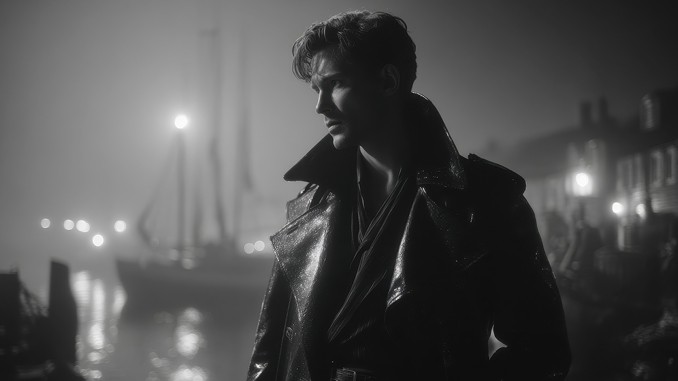

From the novel “The Invisible Side:
A Story of Escape and Destiny”
by Aleksander Rybczyński
Copenhagen, 1970s. Jan Wojkowski, a Polish microbiologist who escaped communist Poland by yacht, conducts research on tularemia at a prestigious Danish institute. His son Michał, armed with a Nikon camera, begins to notice shadows following them—signs of surveillance that stretch from Copenhagen to the Danish island of Bornholm. When Borys, an American intelligence agent and family friend, arranges an urgent meeting on a deserted beach, the truth emerges: Jan’s research has attracted the attention of both Cold War superpowers, and shadowy elites whose plans for a world government were already taking shape in those years.
Truth on the Beach
Borys opened the door of the green Mercedes W115. The Wojkowskis climbed in, and the car took off with a screech of tires.
“We’ll go somewhere safe,” he said, gripping the wheel with one hand. “I don’t even trust Bornholm anymore—houses left unlocked.”
The Mercedes headed south through Pedersker to Strand Mølle Odde—the deserted beach where Michał had spent nearly every day lounging on the sand and swimming in the warm Baltic.
They got out and descended the embankment. Wind whipped off the sea, swallowing words.
Michał’s heart pounded. Why had his father and Borys gone to such lengths to find him? What was this spy-novel scene about?
Borys lit a cigarette and stared at the waves.
“The time for secrets is over,” he began, voice steady but weighted with years of risk. “Things have gotten complicated. I have to vanish—completely. But first we talk. I’m in a corner.”
Jan glanced around nervously, as if someone might be watching.
“Janek, we didn’t meet by accident,” Borys went on. “I was keeping an eye on you—a mission to get close to your research. American intelligence sent me. My Russian let me blend into émigré circles and their KGB contacts. Routine assignment. But at some point I started playing both sides. The stakes rose, and I… I like the edge.”
He exhaled smoke.
“We became friends. That helped me see there are no clean players—no true defenders of freedom or democracy.”
“You betrayed our friendship,” Jan said, voice hollow. “You followed me. Reported on me.”
“It wasn’t like that. I quickly figured out who was playing dirty—who the real traitors were—and which side a decent man should stand on. I still think I’m decent. But it doesn’t matter now. The Russians—and PRL intelligence under them—have their own breakthroughs. Moscow microbiologists reached results similar to yours. That’s why you’re no longer prime prey. They don’t need your microfilm anymore. They’ll manage without it.”
He paused.
“That doesn’t mean you’re safe. Or that they’ll leave you alone. It’s a big unknown.”
“My advice—contact the Americans fast. I can still arrange it. Sell them the microfilm, quit Nordisk, disappear. I don’t know how or where. Buy a seaside house, farm. Or better—an ocean yacht. Sail the world with Alicja. She’s always dreamed of it, hasn’t she? Wait for a call, a signal—meet them, Janek. Best advice I can give. It’ll get you out of this cat-and-mouse game.”
He gave a bitter smile, eyes on the sea.
“I told you once, Michał—your Nikon sees everything. The shadow on Vesterbrogade, the embassy limousine… just the tip. Listen close; I won’t say this twice.”
His voice hardened.
“In 1971, in Davos, Klaus Schwab—a German opportunist—gathered people you won’t read about in papers. They called it the European Management Forum. Sounds like a businessmen’s club—‘future of the economy,’ ‘better world.’ But I saw their hidden publications. It’s not just Davos. It’s tied to the same elites as Bilderberg.”
He turned, intense.
“They talk ‘managing the future’—biology, control over life. That’s the plan: precise, global. A world where every step, every thought is on their leash. Absolute power—not with tanks or old tyranny, but technology, data, systems built in shadows. Schwab’s forum is their new mask—less secret than Bilderberg, just as dangerous.”
He took another drag.
“They can be exposed. But it’s risky. They’ve tracked me for years. Now they know I have principles. Across the ocean I might find peace, but you…” He looked at Jan. “Your research is key. If they twist it for their ‘new order,’ the world we know ends.”
His voice dropped.
“Don’t trust Davos smiles. This isn’t a better world—it’s a world government crushing individuals. Hold to truth, but remember: truth isn’t free. And you don’t need to look behind you—the shadow’s already there.”
“We didn’t come to Bornholm just to talk, Michał. There was a reception at the Russian embassy. Invited Americans. One drank too much—blabbed I work for them too. I’m burned. I thought it was a drunk agent’s slip, but no illusions now. It was deliberate. The Americans know I see too much, won’t dance to their tune. No sentiment. They serve other masters—the ones I mentioned. Schwab’s puppets, Bilderberg’s. Idealists like us don’t belong in their ranks—or their crosshairs.”
He stubbed the cigarette.
“I was sold out on purpose. They want me gone. Probably think the Russians will handle it quietly. For now they pretend to cover me. I need to reach Rønne port. Evacuation from there. Karin and the kid are already across the ocean. I’ll settle in Denver, Colorado.”
He handed Michał the Mercedes keys and registration papers signed over.
“Sell it. Don’t be seen driving my car. Back in Copenhagen, mailbox has shop keys. Take what you need—but it’s probably watched.”
The men talked a few minutes more, then shook hands, climbed the embankment, and got into the green Mercedes. They drove to Rønne port.
Borys stepped out and walked the pier toward the open sea, where ferries to Copenhagen departed.
Jan and Michał watched from a distance.
After half an hour, a large navy-colored motorboat appeared at the harbor entrance. It pulled alongside the pier. Borys leaped aboard nimbly.
The boat sped away without a wave goodbye.
Aleksander Rybczyński
Aleksander R ybczyński, poet, writer, art critic, editor, photographer, reporter, and journalist; graduate of the Jagiellonian University (art history); since 1991 lives in Toronto, Ontario.
Author of several poetry collections, recipient of the Kazimiera Iłłakowiczówna Award (for the best poetical debut) and the Turzański Foundation Award (2000).
Since 1991, has made numerous contributions to the Polish-Canadian periodicals and TV programs. Between 1993 and 2003, editor of the cultural monthly “List oceaniczny” (Oceanic Letter). From 2015 on, editor-in-chief of the online magazine “Polska Canada” (bilingual), devoted to literature, art, socio-political commentary and history, as well as to the preservation of Western cultural values, and to the human, national, and animal rights.
Fot. Hanka Kościelska