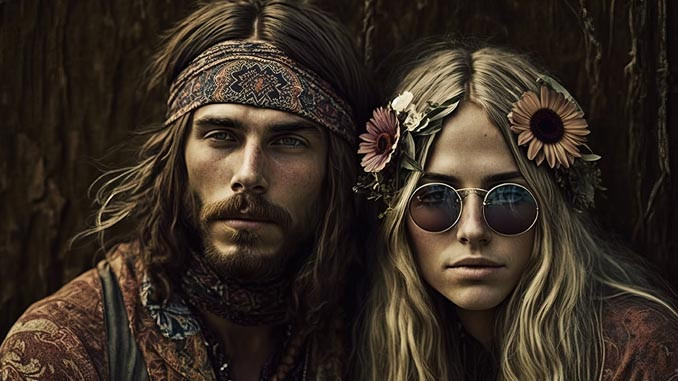

From the novel “The Invisible Side” by Aleksander Rybczyński
Copenhagen, March 1982. Michał Wojkowski, now a medical student, reconnects with Thomas and Sophie—the hippies who once rescued him and his mother during their dramatic escape from occupied Czechoslovakia in 1968. Over coffee at Café Sommersko, the conversation turns to dreams abandoned and ideals compromised. Denmark has joined the European Economic Community, Greenland voted to leave it, and in Poland, martial law has crushed Solidarity. The flower children of the ’60s now wear business suits and speak the language of pragmatism. But as Michał walks home through gray Nørrebro streets, he wonders: Is this wisdom—or capitulation? And what does freedom really mean when everyone eventually stops fighting for it?
Flower Children
For years he’d maintained phone contact with Thomas, but these were perfunctory conversations, quickly ended, as if time was chasing the speakers. He decided to change this and arranged to meet his friends. That March afternoon in 1982, he entered Café Sommersko on Nørrebro, where they’d met years ago. For a moment he wondered if these were the same people. Thomas, once with long hair and a Viking beard, had short-cropped hair and a gray wool blazer. Sophie no longer wore a flowered skirt, just dark pants and a sweater. Only her silver bracelets recalled old times.
“Michał!” Thomas called, rising from the table.
The embrace was warm but settled—something had changed. They sat by the window, ordering coffee and Danish wienerbrød. Outside the window, Nørrebro pulsed with life—cyclists zipped through March cold. The cafe smelled of cinnamon and freshly brewed coffee.
“I wouldn’t recognize you on the street,” he laughed, looking at his friends. “What happened to the flower children?”
Thomas laughed bitterly.
“Years fly by, friend. We have jobs, bills, a mortgage on an apartment. Sophie teaches at a preschool, I design at an architectural office. Not everyone can be an eternal student like you,” he joked.
Sophie squeezed his arm.
“Thomas is exaggerating. It’s just… the world has changed. We have too.”
She looked through the window at passersby in dark coats hurrying through the gray day.
“Do you remember our conversations about the EEC? About how it was the end of Danish independence?”
“I remember,” Michał nodded. “You were opposed.”
“We voted ‘nej,'” Thomas said, stirring his coffee. “And so what? Denmark entered the Community in 1973, and life didn’t end. On the contrary—more opportunities appeared, travel, work abroad. Maybe we were too idealistic.”
“There’s still the problem with Greenland,” Michał looked at Thomas with irony. “They voted in a referendum a month ago. They want to leave the Community.”
Thomas waved his hand.
“They have different problems. The fishing policy is strangling them—I understand that. But we continental Danes are in a different situation.”
“Those ‘other problems’ are more important than fishing,” Michał pressed on. “Denmark didn’t treat the Inuit well: children were taken from parents, girls were forced to undergo procedures to prevent pregnancy, which in many cases had fatal consequences for their health. That must have been the last straw.”
“Relations between nations are usually controversial,” the surprised Dane objected uncertainly. “You don’t know the details, so it’s easy for you to judge critically decisions that didn’t come from bad intentions.”
“So, not everyone is happy with Brussels?”
Thomas got irritated.
“I’m not saying the system is perfect. But you have to be a realist.”
Sophie sighed.
“It’s easy to be a revolutionary when you’re twenty years old and living on your parents’ dime. But when you have to pay electricity, food, rent… It changes your perspective. The system isn’t ideal, but it works.”
Michał felt torn. These people who once inspired him with rebellion now spoke a pragmatic, reasonable language, but less true. Had they betrayed their ideals? He remembered One Flew Over the Cuckoo’s Nest and Chief Bromden ripping out the console to run to freedom. “Soon he’ll be far from here, transformed into Great Mountain, and you stayed in the hospital,” he thought.
“What about your dreams?” he asked. “About music, transforming the world?”
Thomas smiled sadly.
“Hendrix has been dead for years. Morrison too. Lennon… do you remember December 1980? When I heard about the assassination of John, something broke in me. Those who couldn’t be bought had to die.”
He said it as if something more hid behind the words. But maybe it was just Michał’s illusion, who since his discussion with Borys looked for double meanings everywhere. The former hippie continued, pointing at the radio from which synthesizer pop flowed.
“Now we have ABBA and Björn Borg. Swedes are conquering the world with tennis and disco.”
“Maybe that’s not so bad,” Sophie added, though uncertainty and resignation sounded in her voice. “Maybe the world needs less rebellion and more stability. Peace. Normalcy.”
“You’re talking about what’s being hyped and served to us on a plate,” Michał countered. “The big things never make the headlines. I listen to ABBA too, but my heart is more with Karel Kryl, the Czech bard whose singing I first heard in a Prague apartment right after the invasion. He’s in exile in Munich now, working for Radio Free Europe, still creating—but who talks about him today? He’s condemned to silence. The authorities in Prague jam his broadcasts.”
He also thought of his parents, still fleeing on the Horisont from shadows of the past. Thomas had once said: “The EEC is a machine driven by corporations and capitalist governments. Denmark will lose its sovereignty, and Brussels will tell us how to live.”
“What about fighting the system? Distrust of power? I guess Kerouac has found his way back to the secondhand bookstore?” he added, unable to resist the allusion to the famous “bible of freedom.”
The ex-hippie looked at him with a uncertain smile.
“On the Road still has a place of honor in the library. But you’re right. Now it just gathers dust. These days we read Updike more. Rabbit, Run. Every Rabbit eventually sits down. When you’re thirty-two, you’ll understand there are no ideal systems. There are only worse and better ones. Denmark in the EEC isn’t the worst place, right?”
He fell silent.
“Yesterday I heard about Poland. Martial law, Solidarity underground, Wałęsa interned. I thought about your parents. Isn’t boring democracy better than fascinating revolution?”
Sophie touched his hand.
“It doesn’t mean we gave up. The world poses new challenges. Thomas uses solar panels in his designs, I teach children civic responsibility, but I also try to instill in them respect for nature. That means something too, right?”
Michał nodded, though he completely disagreed with her and felt bitterness. “Civic responsibility”? It sounded like something straight out of a Party secretary’s speech. These rebels from his youth spoke the language of compromises and conformism. Contrary to appearances, this wasn’t wisdom but capitulation. Through his head flashed words from T.Rex’s song “Children of The Revolution”:
But you won’t fool, the children of the revolution
No, you won’t fool, the children of the revolution
Now it sounded like irony. But maybe Thomas and Sophie still had a spark in them, just suppressed by the action of a state that screwed ideals into the grinder of everyday life?
“And you?” Sophie asked. “I heard you’re studying medicine. That must be fascinating.”
“Sometimes,” he replied. “But you know… I have the feeling we’re all giving up. Instead of changing the world, we adapt. My parents fled to the ocean, you hide in stabilization, and I… wait.”
“Wait for what?”
He looked at the gray street of Nørrebro. What was he waiting for? For love? For a letter from his parents? Or maybe for Borys, who like Hamlet’s ghost knew answers?
“I don’t know,” he said honestly. “Maybe for a sign it’s worth fighting. Or for news that my parents are safe.”
Thomas and Sophie looked at each other. In their eyes flashed concern, maybe longing for lost convictions.
“You know,” Thomas said, “Maybe they don’t call us ‘flower children’ anymore, but we’re still your friends. If you need anything, you can always count on us.”
Sophie smiled warmly.
“Some things don’t change. Friendship is one of them.”
They said goodbye effusively, shaking hands for a long time, as though confirming the durability of their friendship, or perhaps trying to erase the bad impression. The feeling of bitterness lingered. Michał knew the bond with his former hippie friends would survive the test of time, but their understanding would never again be as open and carefree as it once was. The conversation—its phrases still echoing in his head—was full of implications, justifications, and resignation from convictions once unquestionable. He felt regret and dissatisfaction, but also fear that someday he might give up on himself for the sake of comfort and a conflict-free career. He had once laughed at the Free Speech Movement’s warning not to trust anyone over thirty. After this conversation with his friends, he was no longer sure it was just a joke. He noticed how easy it was to explain away the betrayal of ideals to oneself and others—all it took was sophisticated manipulation hidden behind a good-natured smile and strained arguments.
Returning to Enghave Plads, he tried to shake off the weight of these reflections and let his thoughts run ahead into the future. He remembered the letter from Krzysztof. Code 303. Colorado. Borys. But above all he thought about the phone call to Poland—the one that would change his life. Code 61.
Aleksander Rybczyński
Aleksander R ybczyński, poet, writer, art critic, editor, photographer, reporter, and journalist; graduate of the Jagiellonian University (art history); since 1991 lives in Toronto, Ontario.
Author of several poetry collections, recipient of the Kazimiera Iłłakowiczówna Award (for the best poetical debut) and the Turzański Foundation Award (2000).
Since 1991, has made numerous contributions to the Polish-Canadian periodicals and TV programs. Between 1993 and 2003, editor of the cultural monthly “List oceaniczny” (Oceanic Letter). From 2015 on, editor-in-chief of the online magazine “Polska Canada” (bilingual), devoted to literature, art, socio-political commentary and history, as well as to the preservation of Western cultural values, and to the human, national, and animal rights.
Fot. Hanka Kościelska