

For Misia
The desecrated church stood at the junction of two dirt roads—one leading toward the burned-out shell of a manor house, the other toward the ruins of an abandoned village. Its once whitewashed walls were blackened in places by fire and pockmarked with brick-red scars from shrapnel. Crude shutters, fashioned from poorly fitted-together planks, covered its three tall windows. From the decapitated bell tower hung crookedly a wooden chute, installed there before the war when the kolkhoz administration had ordered the useless building to be converted into a granary.
Inside the dimly lit nave, against the eastern wall, stood a stone altar elevated on three steps. Lying beside it was an unconscious man. Clad in filthy striped rags, he was dying. A large gray cat, perched on a wooden partition of the granary, stared down at him with luminous amber eyes, listening impassively to the man’s labored, rattling breaths.
Outside, the winter twilight was descending. A cold northerly wind carried the sharp scent of cordite and fear. The ground trembled from the distant thunder of artillery. The setting sun appeared as a pale, gray disc against a smoky horizon, slashed now and then by the flashes of explosions.
Something moved at the edge of the nearby forest. A large German shepherd with a wide leather collar crept out from among the tall, snow-dusted pines and spent a long time sniffing the air. Sensing no sign of danger, he rose to his feet and trotted toward the chapel. Upon entering, he did not even glance at the motionless cat but went straight to the man. The scent of a concentration camp prisoner made him growl and raise his hackles; a moment later, however, he relaxed, let out a soft whimper, and settled down beside the unconscious man.
The edge of the forest stirred once more. A chestnut mare in military harness emerged slowly into the open, dragging the swingletree of an ammunition limber behind her. She followed the dog’s tracks but came to a halt before the entrance to the church. There, she snorted once, then stood motionless in the deepening cold.
The wheezing breath of the man lying by the altar suddenly fell silent. The dog edged even closer to him, warming the man with the heat of his muscular body.
Now, one after another, a gaunt sow, a black-and-white mongrel bitch, and a red cow emerged from the forest. Treading across the crystalline shroud of snow, they made their way toward the church. The smaller animals entered the sanctuary; the cow remained outside, beside the mare.
As the faint new moon wandered across the sky, more animals appeared. Sheep, horses, dogs, pigs, and goats, drawn by some invisible force, made their way toward the church and the man who lay dying within it. The larger animals halted near the mare and the cow, while the others entered the building and lay down before the altar, upon the dusty, cracked flagstones of the floor.
At last, the darkness of night enfolded the church. The animals, standing or lying in silence, turned their heads toward the motionless human figure. The man suddenly shuddered, let out a groan, and grew still once more.
Then the chapel walls became covered with shimmering, translucent mirages of their former splendor. On the eastern side, a carved and gilded altar reappeared, looming over the man’s lifeless body. Large, age-darkened canvases in ornate frames hung suspended halfway between the marble floor and the vaulted ceiling. An alabaster knight returned to the tomb niche beside the entrance, reclining on his elbow, an ornate mace in his hand. The tower, once again topped with a green copper helm, shed the wooden chute, which crashed to the ground with a clatter.
From above the altar, billowing clouds of glory descended majestically, filled with a multitude of angels, archangels, cherubim, and seraphim—a vast, swirling throng of multicolored wings, radiant faces, and gleaming robes. They bore a golden throne, adorned with jaspers, sapphires, chalcedonies, emeralds, sardonyxes, carnelians, chrysolites, beryls, topazes, chrysoprases, hyacinths, and amethysts. Upon the throne sat Jesus Christ, King of Kings and Lord of Lords, clad in snow-white raiment and girded with a scarlet sash, a tall crown, shimmering with rubies and diamonds, resting upon His head.
The terrified animals pressed themselves against the floor, trembling. Only the cat remained motionless, perched on a wooden partition, staring at the Ruler of the Universe with amber eyes.
Christ leaned forward on His throne and reached out toward the man’s prone body. The righteousness and innocent suffering of the deceased took the form of a white dove, which, fluttering its wings, alighted upon Jesus’s hand. He entrusted this soulbird to one of the angels, then looked down at the gathered animals, who raised their humble eyes toward the face of the Savior of Mankind. In it, they beheld infinite love and infinite compassion. This gave them the courage to speak. First came a solitary howl, followed by a tempest of roars, neighs, grunts, and whimpers. Each animal spoke in its own tongue, and King Jesus understood them all.
The animals cried out about constant hunger, brutal beatings, and festering wounds; about lives spent in grueling toil that ends only at the gates of the slaughterhouse; about their newborns taken away from them, tossed into sacks and drowned, or killed before their mothers’ eyes; about pervasive filth and neglect; about being trained to become tormentors of other creatures; about maiming and death in the endless wars of humans; about living, sentient beings seen merely as meat; about trust repaid with betrayal, and love met with cold indifference.
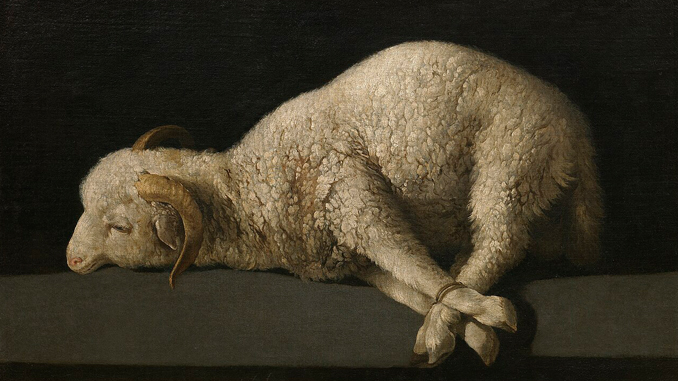
The animals’ clamor reached a deafening crescendo and then abruptly fell silent. Jesus gazed for a long while at the now hushed throng, then slowly rose, removed His crown, placed it upon the empty throne, and changed His shape into a white lamb, the Savior of All Life.
The Lamb of God nimbly jumped among the animals, while His throne, angels, clouds, and church mirages faded into nothingness. The animals surrounded Him in a circle; the braver ones came as close as possible, sniffing or licking His curly fleece. When the lamb knelt and lay down on the cool slabs of the floor, the German shepherd squeezed through the ring of bodies and again offered his warmth to the Incarnate God.
The night hours passed. The animals lay motionless, basking in the peace beyond understanding that radiated from the lamb in their middle. At last, the grey light of a winter dawn crept in through the church entrance.
The German shepherd sensed it first: he pricked up his ears, let out a warning bark, rose, and trotted quickly out of the chapel. One by one, all the other animals followed him. The last to stir was the gray cat—she leapt down from her perch, approached the lamb, brushed her fluffy cheek against His muzzle, and fixed Him with a long stare that knew the eternity of good and evil, then disappeared without a sound into a cranny in the wall.
Outside, human voices sounded. Several women and an elderly man, carrying shabby bundles containing their few possessions, were coming from the direction of the forest. When they entered the desecrated chapel, they still crossed themselves, as befitted good Christians. Then they saw the lamb looking at them trustingly with His big brown eyes, and their faces lit up with joy. The man leaned over the lamb, lifted Him slightly from the floor, and with one practiced move slit His throat.
Mariusz Wesolowski
About the Author:

Mariusz Wesolowski (b. 1954) – a graduate of Polish philology and art history at the Jagiellonian University (Krakow), since 1982 lives in Canada.
.
Illustration: Francisco de Zurbarán, Agnus Dei, circa 1635-40, Museo del Prado, Madrid.


